
About
The Wallerstein Institute is a non-profit center and global network of thinkers across intellectual and creative disciplines, providing spaces of encounter, education, collaborative research, and collective reflection and imagination around democratic world futures.
BACKGROUND
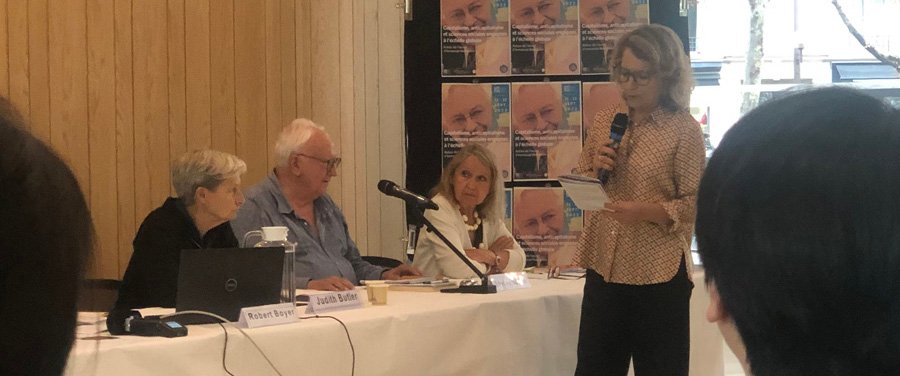
In September 2023, a conference was held to address the work and legacies of Immanuel Wallerstein at the Fondation Maison des sciences de l’homme in Paris, which, along with the Fernand Braudel Center for the Study of Economies, Historical Systems, and Civilizations was Wallerstein’s intellectual home for 40 years. The conference gathered scholars from within the world-systems analysis tradition but not only. Scholars from the fields of geography, literature, postcolonial studies, and feminist theory, as well as social scientists and historians from other traditions, took part in a rich two-day conversation on the legacies of Immanuel Wallerstein within and beyond his fields of sociology and economic history. The outcome of the event was not just a celebration of Immanuel’s thought. It was also a dynamic and successful experiment in uniting thinkers from different traditions and generations who would not normally be in conversation with one another around the common cause of historicizing capitalism and its spoils, and laying the grounds, both intellectual and practical, for a better and more just world. When the conference ended, a number of participants spoke about building on the momentum of the event. The creation of this Institute, two years after the initial event, is that next step.
CONCEPT
The purpose of the Wallerstein Institute is to create a space, figuratively and literally, for collective critical and creative reflection, for the generation of ideas, and for pedagogical encounter in the service of a significantly more democratic world. Through spaces of thinking, creating, and learning together, with the significant involvement of younger generations, we assert a collective commitment to the future, to a future, in the face of a time saturated with the urgencies of the present.
The Institute builds on Immanuel Wallerstein’s analysis of the capitalist world-system and the structural (he would say terminal) crisis it now faces. It draws from his work on antisystemic movements and of the movements themselves that emerged during and after his time. The Institute is intended as an evolving venue (along with partner venues) for inquiry, experimentation, and the development of new ideas and strategies with democracy, equality, living in common, and internationalism its core values. While the broad visions of the postwar era and particularly of the 1960s and 70s gradually shifted toward more fragmented political expressions, the impact of these historical movements, along with those of the late 20th and early 21st centuries, continue to shape the landscape of social action. Though many of these efforts have encountered setbacks or opposition, they have also opened new avenues and models for collective engagement. Learning from these experiences and practices, along with the theoretical structures that have accompanied them, remains essential, as does finding the tools and shared language needed to build meaningful international connections today—perhaps in ways that are more accessible than they first appear.
The Institute draws upon another crucial legacy, symbolized by the two institutions which Wallerstein built (the Fernand Braudel Center for the Study of Economies, Historical Systems, and Civilizations, or FBC) and helped build, with Fernand Braudel (the Maison des sciences de l’homme). Each of these provided a fertile haven for a global community of scholars from disparate disciplines within the social and human sciences. The FBC, further, was a magnet for thinkers and actors who did not necessarily have an academic background, but who sought to understand the history and the present of the political economy of the world so as to better act upon it. These were places of intellectual, political, and social ferment, within which a range of radical thought was birthed and fostered. This Institute draws upon that legacy as well. In this time of the privatization of the university, the enclosure and making illegal spaces of dissent, and the slow bleeding of funding for the arts, humanities, and social sciences, the need for para-university structures founded on freedom of thought and expression is urgent.
There is, of course, another urgency. It is increasingly clear that we are living through a period of rising political polarization, the strengthening of far-right movements across the globe, and new fascisms—alarming developments that call for renewed protected spaces for collective reflection and collaborative action.
Immanuel Wallerstein anticipated such a period, part of the structural crisis in the world-system, characterized by volatility in markets, shifting geopolitical dynamics, a proliferation of wars, and efforts by powerful actors to preserve their influence through both institutional control and information management. He argued that the current world-system is approaching the end of its historical cycle, and that the transition ahead could take multiple forms. On one end, it could move toward a more inclusive and democratic global order—what he referred to as the "spirit of Porto Alegre," in reference to the World Social Forum held in Brazil in 2001, whose manifesto was published with the title of “Twelve Propositions for Another Possible World,” and on the other, toward deeper inequality and entrenched hierarchies—what he called the "spirit of Davos." Wallerstein believed the outcomes were uncertain—what he framed as a 50-50 proposition—but emphasized that periods of systemic transition offer rare opportunities for meaningful change. He encouraged engagement at all levels, grounded not in idealism but in a belief that thoughtful, coordinated action can shape the trajectory of what comes next.
SPACES OF ENCOUNTER, EXCHANGE, AND EXPERIMENTATION
The Institute and its spaces of encounter are intended as a response to Wallerstein’s invitation to engage critically with the challenges of our time. The aim is to create opportunities for diverse groups and individuals—across disciplines, generations, and regions of the world—to come together to think collaboratively, with both creativity and rationalism. It is a place that values open dialogue, including disagreement and dissent, as part of a shared commitment to inquiry and understanding. The Institute supports experimentation in both thought and practice, and encourages reflection grounded in uncertainty rather than rigid certainty. It also seeks to facilitate the exchange of knowledge across traditions and perspectives—connecting approaches such as world-systems analysis, historical materialism, and Marxian theory with feminist thought, critical race studies, gender-diverse perspectives, literary and cultural theory, and the arts. At the same time, the Institute aims to support education more directly, fostering intergenerational learning, and enabling the dissemination of ideas across formal and informal settings and venues. It hopes to contribute to the formation of new groups and networks, to collaborate with existing ones, and to build a culture of engagement grounded in shared values of openness, curiosity, and mutual respect.
PHYSICAL DETAILS
The Wallerstein Institute is located in Paris, at the Fondation Maison des sciences de l’homme, an umbrella structure for social science networks and research, to which Wallerstein first came in 1975 at the invitation of its founder Fernand Braudel, and where he spent regular time over the next 40 years of his career.
The Institute will also be seeking a large structure in a rural location in France, easily accessible by train to Paris, to serve as a more secluded gathering place for residencies, seminars, research working groups, and collaborations of other kinds.
The Institute will have satellite locations through our global partners, where activities will also take place.

The Institute’s director and board members.

The Institute’s advisors.
The Wallerstein Institute is pleased to partner with the following organizations, institutes, presses, and foundations. This list is in development.